

By Augustine Ehikioya
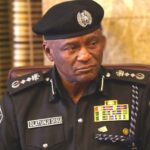
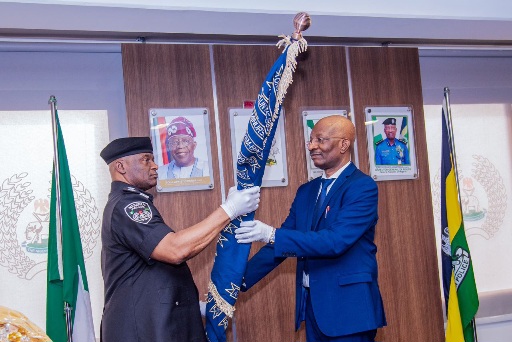
The new Acting Inspector General of Police (IGP), Olatunji Disu, has officially assumed duty as the 23rd Indigenous Inspector General Of Police.

He took over on Wednesday from the immediate past IGP, Kayode Egbetokun.
The new Acting IGP promised to ensuring the protection of lives and property of every law-abiding citizen and all residents across the country.
He spoke during the handing over and taking over ceremony in Abuja. It was monitored by Security Watch Africa (SWA).
Speaking at the occasion, Acting IGP Disu, disclosed that his tenure will be committed to Professionalism and Modernisation, Accountability and Integrity, Community Partnership and Public Trust.
He said “My tenure will therefore be built on three clear commitments.
“1. Professionalism and Modernisation
We will move this Service decisively into the modern era. Intelligence-led policing, forensic investigation, digital tools, and evidence-based practice will define how we work. Not intimidation, not shortcuts, not the abuse of authority. And we will invest in the people who do this work.
“A well-trained officer, properly equipped and genuinely valued, is the most powerful crime-fighting instrument this Service possesses.”
“2. Accountability and Integrity
I will say this plainly, so there is no confusion: the days of impunity are over. The badge is a symbol of public trust. Anyone who treats it otherwise will face the full consequences of our disciplinary processes. This applies at every rank, without exception, including those closest to me. I will not ask the public to trust a Service that does not first hold itself accountable.
“We will strengthen our internal oversight mechanisms, make our processes more transparent, and mean what we say when we speak of the rule of law,” he stated.
“3. Community Partnership and Public Trust
No police service in the world has ever achieved lasting public safety by operating against its communities rather than within them.
“We will go to the people. To the markets, the town halls, the schools, the informal settlements. Not to lecture, but to listen. Community policing is not a programme. It is a philosophy, and it will become the heartbeat of how this Service operates.”
While noting that the Police Force has immense capacities to combat the threats to national security, he said that he was not unaware of the trust deficit the Force has with communities in the country, outdated systems, resource gaps, and culture of misconduct.
“We can confidently boast of brave officers, professionalism, institutional knowledge, passion and a high level of resilience that have enabled Nigeria to conquer many difficult situations.
“I am also mindful of the fact that we also carry wounds: a trust deficit with communities we are sworn to protect; outdated systems, resource gaps, and in some quarters, a culture of misconduct that has stained the badge that many of us wear with honour.
“These are not comfortable truths. But they are truths we must face with a resolve to tackle in order to reposition the Nigeria Police as a very trusted friend that is people-oriented,” he said.
To forge ahead, he tasked his officers on Integrity, Compassion, and Courage.
“These are not optional qualities. They are the job. But I make you this promise in return: I will fight for your welfare, your dignity, and the conditions you need to serve effectively.
“You will not be asked to perform miracles with nothing. Leadership in this Service, from this day forward, must be visible, accountable, and worthy of being followed.”
He urged the Citizens to partner with the Nigeria Police Force by reporting crime.
“Engage with your local officers. Hold us accountable when we fall short, and encourage us when we get it right. We are not your adversaries. We are your neighbours in uniform, and your safety is the only measure by which our success should be judged.
“The road ahead is not smooth, neither is the reform. There will be resistance, there will be hard calls, and there will be moments when the easier path presents itself. I intend to take the harder one.
Assuring that he will operate open door policy, the new Acting IGP added “My ears will be attentive. But my commitment to transforming this Service into one that every citizen can trust, and every officer can be proud to serve in, will not waver.”
On those congratulating him, he said “I am of the strong opinion that it is not yet time for me to be congratulated. It is not yet time because a heavy burden has been placed on my shoulders and those of my colleagues. It is not yet time because I know the expectations are very high. It is not yet time because I know we should not only meet the expectations, but strive to surpass them.“
He commended all the past IGPs for the foundation they laid, their professionalism, dedication, and the structures they worked very hard to build.
“I am not unmindful of the great sacrifices that every one of them made in the course of their respective tenures. My colleagues and I are very grateful to you. I am called to build on that foundation,” he stated.
The new Acting IGP added “I want to let all the officers and men of the indefatigable Nigeria Police, from the fresh recruit still learning the weight of the uniform, to the veterans who have given decades of quiet service, know that Tunji Disu (as most of you call me is first and foremost a Police Officer before being the Inspector-General of Police.
“This, I greatly cherish and wish to continue to be. I see you, I honour you, and I am with you. I know what it means to stand a post in the rain. I am aware of the risks involved in responding to any distress call. I know what it feels like to serve a public that sometimes applauds you and sometimes distrusts you.”
According to him, those experiences will reflect in every decision he will make as the IGP.
Bidding the officers and men of the Nigeria Police Force farewell, Egbetokun maintained that his tenure strengthened intelligence-led policing architecture; expanded digital crime-tracking and forensic capabilities; enhanced inter-agency operational coordination; reinforced internal accountability mechanisms; modernised tactical assets; and intensified specialised training across commands nationwide.
Targeted operations under him, he said, also disrupted organised kidnapping networks, curtailed violent criminal syndicates, improved coordinated response capacity, and restored operational confidence in previously underserved communities.
Egbetokun said “Community-centred policing was deepened as a strategic doctrine, not a rhetorical commitment.
“We also prioritised officer welfare, accelerating promotion processes, strengthening insurance frameworks, expanding housing initiatives, and investing in capacity development because morale and professionalism are inseparable in effective policing.
“Reform was pursued with discipline and clarity. Public trust cannot be commanded by authority; it must be earned through integrity, transparency, and measurable results.”
Stressing that the gains were not the achievement of one office, he said “They were the product of collective resilience of officers who served long hours, made difficult decisions, and stood firm in defence of the nation.”
He went on “To those who operated in high-risk environments, who confronted danger so others might live in peace, I salute your courage. The stability many enjoy today rests quietly upon your sacrifice.”
To the sister security agencies, strategic partners, and international collaborators, he said that their cooperation strengthened the national security architecture and enhanced operational outcomes in his tenure.
“Leadership in policing is custodial. No Inspector-General owns this institution; we hold it in trust for the nation and for the generations who will inherit its future.
“As I hand over to my successor, I do so with confidence in his competence, experience, and strategic capacity. The foundation has been reinforced; the systems recalibrated; the reform trajectory clearly defined.
“I charge him to consolidate these gains to deepen intelligence integration, expand technological modernisation, strengthen accountability systems, and entrench community-centred policing as enduring doctrine. Institutional progress must not pause; it must accelerate.”
To the Nigerian people, he said “I offer a final reflection. Beyond structures and strategies, beyond deployments and reforms, policing is ultimately about trust.
“It is about the assurance that when distress calls in the night, someone will answer; that when communities feel vulnerable, someone will stand between order and chaos.”
He urged for continued partnership, continued vigilance, and continued belief that the institution can and must rise to meet their expectations.
“The promise of security is not sustained by the Police alone it is strengthened by a nation that stands together.
“The burden of command is neither ceremonial nor light. It carries decisions that shape lives, responsibilities that test conviction, and moments that demand quiet courage. I have carried it with humility and now relinquish it with gratitude, confident that the Nigeria Police Force stands firmer than when it was entrusted to my care,” he stated.
He expressed gratitude to President Bola Tinubu, for the confidence reposed in him to serve as Inspector-General of Police and for his steady leadership and sustained support for policing reform.
While also thanking the Police Service Commission for its constructive oversight, he expressed appreciation to the and the collaboration of the Minister of Police Affairs.