

By Augustine Ehikioya
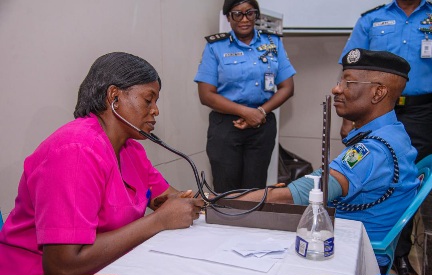
For the Nigeria Police Force (NPF) to succeed in its various operations and activities, the Inspector General of Police (IGP), Kayode Egbetokun, has stated that having a healthy workforce is inevitable.
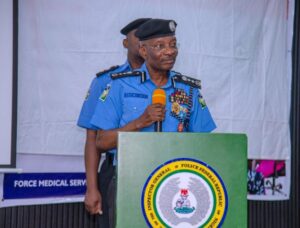
Having good health programmes and facilities, he said, will also go a long way to boost officers and men’s morale.

The IGP spoke in Abuja during the Conference Of Heads Of Police Healthcare Facilities Nationwide.
It was themed “Transforming Policing in Nigeria: The Evolving Role of the Directorate of Force Medical Services”
The conference was covered by Security Watch Africa (SWA).
The policing of tomorrow, the IGP said demands more than courage or command presence, but also resilience, physical, emotional, and psychological.
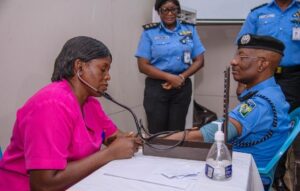
According to him, it demands preparation for the threats been faced externally, and the wellbeing of the men and women who stand on the frontline.
He said “To every officer seated here today, I extend my appreciation. Your work is often quiet, unnoticed, and behind the scenes, yet it is foundational to operational readiness and national security.
‘The Nigeria Police Force cannot deliver its mandate without a healthy support and medically protected workforce. Your role no doubt is strategic to our effectiveness.
“Let this conference therefore be a turning point: one defined by clarity of strategy, alignment of purpose, and, measurable outcomes. The future of policing excellence rests significantly on the strength of our healthcare systems and together, we must build that future,” the IGP stated.
“As we gather here today, we do so with a clear understanding: this conference is not merely an administrative exercise; it is a commitment. A commitment to building a system where those who protect others are themselves protected, supported, and medically empowered to serve at their highest capacity.
“The Nigeria Police Force Medical Services reflects this commitment, and its history reminds us that progress is intentional. Established in August 1975 at Alagbon, Lagos State, it began with a simple but critical vision, to provide structured medical support for police personnel.
“Over the decades, it has both expanded structurally, and deepened in relevance, adapting to the changing demands of policing and national security.
“Today the footprint of this vision is evident across the country with 164 healthcare facilities operating nationwide delivering medical services already enumerated by the force medical director benefitting our officers, their families, persons in lawful custody.”
He said that it reinforces a fundamental truth that the Nigeria Police force is not only an instrument of law enforcement but also a custodian of welfare safety and humanity.
The full upgrade of the Force Medical Services to a full Directorate of the Nigeria Police Force in August 2025, the IGP said, acknowledged the essential role healthcare plays in officer morale, operational readiness, retention, and overall institutional effectiveness.
“With this status comes a broadened mandate, one that requires innovation, consistency, accountability, and strategic leadership.” he stated
Going forward, the IGP said “The expectations on this Directorate grow. We must transition from supportive care to preventive care; from fragmented systems to coordinated frameworks; from isolated facilities to a fully networked medical ecosystem capable of delivering standardized, professional, compassionate, and timely care.
“At the tertiary level, our flagship facilities, notably the Police Hospital Falomo in Lagos State and the Police Hospital Akure in Ondo State; continue to deliver advanced and specialised medical care.
“These hospitals have also become centres of learning and professional development, hosting intern nurses and house officers, and thereby contributing meaningfully to the national pool of healthcare professionals.”
He charged the participants at the conference to think both as administrators and system-builders towards addressing the present gaps and the future needs of policing.
The IGP also tasked them to dwell on digital health integration, trauma support systems, mental health frameworks, emergency coordination, professional accreditation, and sustainable medical staffing pipelines.
According to him, those are the pillars upon which a resilient, modern policing healthcare model must stand.

Speaking earlier, the pioneer Force Medical Director of the Nigeria Police Medical Directorate, Dr. Nkechi Eze, expressed gratitude to the 22nd indigenous Inspector General of Police, IGP, Kayode Egbetokun, for his unwavering support to the Nigeria Police Medical Services (NPMS).
The mandate of the Directorate, she said, was to provide quality health care to serving and retired members of the Nigerian police force, their families, detainees in police custody and the general public, especially during emergencies or industrial actions within the broader health sector.
According to her, its 164 health care facilities across all the police commands, zones and formations are providing multiple levels of care, including sick bay, primary health care, secondary health care services, tertiary health care services.
The services, she said, span through health education, antenatal care, immunization, public health care, outreaches, nursing care, laboratory services, general medical consultation, pharmaceutical care, obstetrics and gynecology, ophthalmology, dental care, physiotherapy, psychiatry, pediatrics, surgery, pathology, radiology, medical records, ambulance services, emergency services and others.
Dr. Nkechi Eze also noted that the transformation in the medical services under the IGP will significantly boost personal welfare, their moral and operational effectiveness, adding “thereby strengthening our national security architecture, so we remain deeply grateful for this remarkable recognition.”
She said that it has ensured that health care becomes a core, institutionalised pillar of policing and has reinforced the capacity to serve with excellence.
“On a personal note, sir, I sincerely appreciate your recommendation, which led to my promotion and appointment as a pioneer Force Medical Director. It is an honour I deeply cherish, sir, and I pledge to actualise your vision of repositioning the Force Medical Services as a strategic investment in the health productivity and operational efficiency of our personnel.
“To drive this vision, we have adopted the slogan, force medical services where relevance meets impacts. We are privileged to have highly qualified and committed healthcare professionals across our facilities,”
The Pioneer Medical Director noted that the Directorate also played pivotal roles during the police games, elections and other national assignments in the country.
She however noted that there are several constraints still hindering the Directorate’s optimal performance.
She listed some of them to include healthcare workers shortages, insufficient basic and advanced life support, ambulances and utility vehicles for medical emergencies, lack of histopathology departments and mortuaries in many of its facilities, inadequate budgetary provision for the state of the art medical equipment, limited funding sources to support critical health care expansion, insufficient training and retraining opportunities for personnel, structural deficiencies in many facilities,
She said there is also need for new structure, staff, to deliver world class health care to police personnel, their families, detainees and the general public, highly equipped secondary health care facilities with state of the art technology in all Police commands across the country, provision of National Trauma Reference Centre in all the geopolitical zones of the country to cater for the trauma related cases, establishment of a standardised school of health as well as the College of Nursing for the training and retraining of healthcare personnel and ensuring sustained workforce supply.

Organisations that gave goodwill messages at the occasion included GS Foundation, United Nations, ICRC, and the National Health Insurance Authority.