


By Bako Christopher
Abuja, Nigeria – The Comptroller-General of the Nigeria Immigration Service (NIS), Kemi Nanna Nandap, has unveiled sweeping technology-driven reforms aimed at strengthening border security, boosting revenue and promoting investment, even as security experts warned that Nigeria’s border architecture will continue to fail unless the Service is fully repositioned as a frontline intelligence institution.


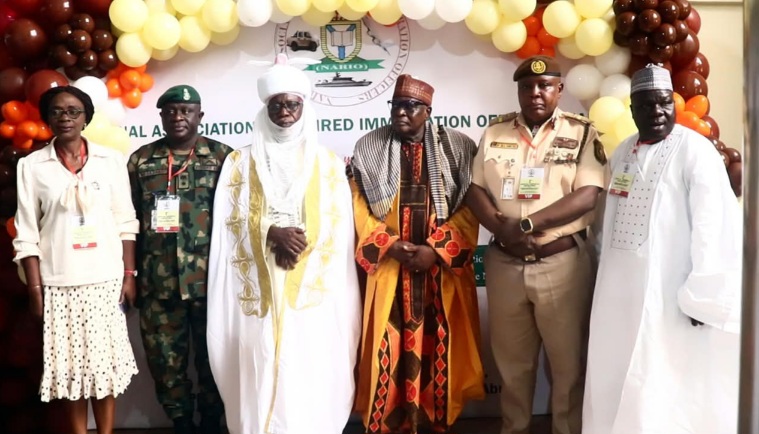
The CGC spoke at the 2026 Annual General Meeting (AGM) of the National Association of Retired Immigration Officers (NARIO) in Abuja, with the theme: Strengthening Institutional Capacity and Autonomy Amidst Operational Challenges: Repositioning the Nigeria Immigration Service for Border Security, Revenue Generation, Investment Promotion and Sustainable National Development.
Represented by ACG SP Jika, Nandap described retired officers as a “reservoir of experience, wisdom and service,” Nandap said their institutional memory remains critical to the growth of the Service.
“You represent a reservoir of experience, wisdom and service. It ensures that the wealth of knowledge gathered over decades of meritorious service to the fatherland is not lost, but harnessed for the growth of the Nigeria Immigration Service,” she said.
She listed reforms undertaken in the last few months to include the Border Management Information System (BMIS), passport automation, e-Border, e-Visa and e-Gates, Performance and Personnel Management Information System (PaMIS), e-CERPAC and the Integrated Operations Centre (IOC) in Abuja for real-time threat detection.
“The success of these reforms depends on one thing: our people. That is why training and retraining remain a cornerstone of my stewardship. As the saying goes, you cannot give what you do not have,” the CGC stated.
Restating the statutory mandate of the Service — control of persons entering and leaving Nigeria, issuance of travel documents and facilitation of safe migration — Nandap said the reforms directly support the Renewed Hope Agenda of President Bola Tinubu in revenue and foreign direct investment.
In a major welfare move, she announced she has directed the Deputy Comptroller-General, Finance and Accounts, to compile all outstanding liabilities relating to retirees, including death benefits, repatriation allowances, pensions and other entitlements.
“I feel your pain, I hear your concerns, I understand the burden. Let me assure you, there is light at the end of the tunnel. You are not forgotten. You are the institutional memory of this Service,” she assured.
She also disclosed plans to establish an Immigration Resource Centre to formally tap into the expertise of retired officers, in line with best practices in other security agencies.
Delivering the keynote address titled _”Repositioning the Nigeria Immigration Service for Border Security: Navigating Contemporary Threats through Technology, Synergy and Policy,”_ security and intelligence expert, Dr Kabir Adamu, commended the reforms, including e-passport, e-Visa, contactless biometrics and MIDAS linked to INTERPOL I-24/7, but warned technology alone has not closed operational gaps.
Adamu said Nigeria’s 4,454km land borders and 853km coastline face Critical and High risks in 2025/2026, including terrorism and insurgency, banditry and mass kidnapping, and transnational crime, compounded by ungoverned spaces like Sambisa Forest, Kainji Lake National Park, Gongola Forest and Lake Chad Basin.
“These spaces have become safe havens and launchpads. Groups like ISWAP and Lakurawa enforce their own laws, tax populations and use the corridors for arms, drugs and human trafficking,” he said.
He identified six compounding failures crippling border security: Militarisation without intelligence; over-centralisation of decision-making in Abuja; kinetic-heavy reactive operations; weak civilian trust due to past abuses; poor inter-agency coordination among DSS, NIA, DIA, Police, Customs and Immigration; absence of a local intelligence fusion mechanism
“Farmers know bush paths armed groups use, traders know which markets handle smuggled goods, women notice when strangers arrive in villages at night. This is intelligence formal agencies cannot replicate, yet there is no formal, protected reporting channel,” he said.
On maritime security, Adamu disclosed that piracy and crew kidnapping in the Gulf of Guinea cost Nigeria an estimated $25.5 billion annually, crude oil theft $2 billion and Illegal, Unreported and Unregulated (IUU) fishing $70 million, calling for urgent repositioning of the NIS Marine Command through integration with NIMASA’s Deep Blue Project, the Navy’s Falcon Eye surveillance and the regional Yaounde Architecture.
He highlighted the e-Border Surveillance Project with thermal and optical masts covering 10-15km by day and 5km at night, and 80 planned remote border nodes, but called for BMIS expansion with Advanced Passenger Information (API) and Passenger Name Record (PNR) for vessels.
Adamu also proposed a phased roadmap: short-term (0-6 months) implementation of the validated National Migration Policy 2025, digital landing/exit cards and body-cams; mid-term (6 months-2 years) ECOWAS and Alliance of Sahel States (AES) identity-sharing pacts, centralisation of NIMC/INTERPOL lookups in BATTIC and solar-powering of all 84 control posts; and long-term (2-5 years) creation of a Border Infrastructure Fund, Rapid-Response Mobile Teams and long-range UAV drone commands.
He urged NARIO veterans to offer institutional memory, advocacy and mentorship to transform Nigeria’s borders “from lines of vulnerability into resilient frontiers of security and prosperity.”
The AGM brings together retired senior officers of the NIS to deliberate on ways to support border governance and national development.