

By Elizabeth Tanko
Calabar, Nigeria – The Chief of Army Staff (COAS), Lieutenant General Waidi Shaibu, has underscored the strategic importance of strengthening amphibious warfare capabilities as part of ongoing efforts to build a more professional, adaptable and combat-ready Nigerian Army capable of responding effectively to emerging security challenges.
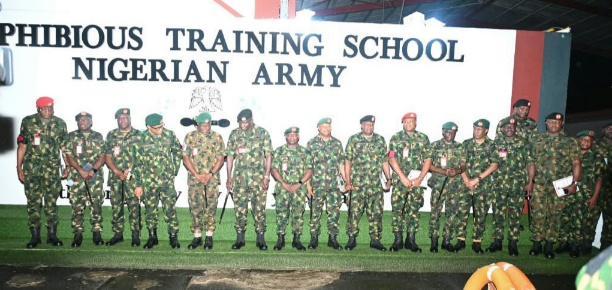
Colonel Appolonia Anele, Acting Director Army Public Relations in a statement, said Gen Shaibu made the emphasis during an operational visit to the Amphibious Training School (ATS), Calabar, Cross River State, to assess its capacity to deliver specialised training for troops operating in challenging aquatic, riverine and littoral environments.
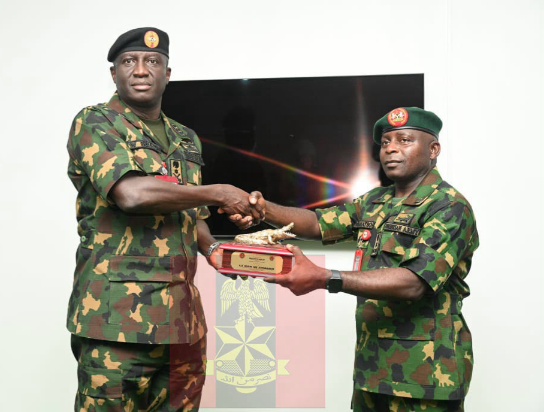
On arrival, the COAS was received by the Commandant, Brigadier General Mathias Ibawa Amatso, who briefed him on the school’s training programmes, facilities, achievements and challenges.
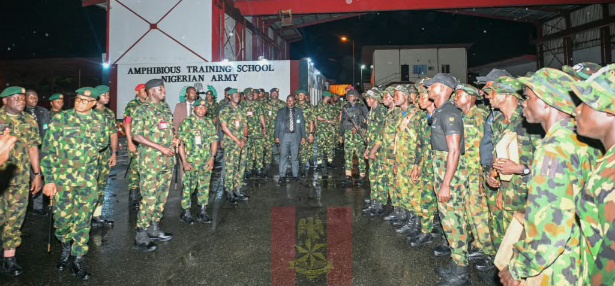
General Shaibu also interacted with instructors and trainees, during which he assessed the quality of training and the institution’s contribution to developing specialised military competencies.
The COAS commended the school for its critical role in producing personnel equipped with the skills and expertise required to conduct operations across rivers, creeks, wetlands and coastal environments.
He noted that amphibious proficiency enhances troop mobility, operational flexibility and combat effectiveness, particularly in difficult terrains that terrorists, insurgents and other criminal elements could exploit.
He further stressed that the growing complexity of Nigeria’s security environment makes specialised military training indispensable, particularly in securing strategic waterways, protecting critical national infrastructure, disrupting criminal networks and supporting joint operations with sister Services and other security agencies.
General Shaibu observed that the Federal Government’s ongoing efforts to expand the Nigerian Army’s formations, strengthen manpower and modernise its operational capabilities must be matched by corresponding investments in military training institutions.
He noted that institutions such as the Amphibious Training School play a vital role in translating the Army’s expansion and modernisation objectives into practical combat capabilities by equipping personnel with specialised knowledge, operational skills and the adaptability required for contemporary warfare.
He emphasised that the Nigerian Army’s training institutions remain critical to force generation, professional development and operational readiness, adding that their facilities, instructional aids, training methodologies and manpower must continually evolve to meet the demands of an expanding and technologically advancing force.
He therefore urged instructors to sustain high training standards while encouraging trainees to uphold discipline, resilience and professionalism.
The COAS assured the school of Army Headquarters’ commitment to supporting the upgrade of its infrastructure, training facilities and instructional aids to strengthen its capacity to deliver quality specialised training.
He reiterated that developing highly skilled personnel remains central to building a responsive, resilient and combat-ready Nigerian Army capable of decisively discharging its constitutional responsibilities.