


By Elizabeth Tanko, Abuja
Abuja, Nigeria – The Federal Government has restated its shift from purely kinetic operations to technology and intelligence-led security operations, while calls intensified for dedicated funding for the Armed Forces.
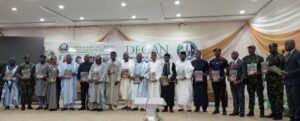
This was the thrust of the 3rd Defence Correspondents Association of Nigeria (DECAN) Conference on National Security and Awards Ceremony held in Abuja on October 12, 2026.

Speaking as Special Guest of Honour and newly invested Grand Patron of DECAN, the Minister of Defence, General Christopher Gwabin Musa (Rtd), said the theme reflects operational reality.
In remarks delivered on his behalf his Special Adviser, Foreign Relations, Air Commodore Steven Ogunmodede, Musa noted that public perception of security has been dominated by visible actions such as troops deployed and territory recovered, but today’s threats are complex, adaptive and interconnected, exploiting information, technology and financial systems.
“Intelligence-led operations – the ability to identify a threat early, understand its networks, anticipate intentions and act with precision – can make the difference between preventing an attack and responding after lives have been lost,” he said.
He stressed that technology strengthens surveillance and analysis but does not replace human judgement, discipline and professional competence, and urged responsible journalism that balances public right to information with operational security.
Also speaking, the Minister of Information and National Orientation, Mohammed Idris, represented by the Director-General of Voice of Nigeria, Mallam Jibrin Baba Ndace, said defence reporting demands courage and sound judgement.
He said President Bola Ahmed Tinubu’s Renewed Hope Agenda places national security at the centre of development, with modernisation of the Armed Forces, improved surveillance and stronger inter-agency coordination.
He recalled that in August 2026, the President directed preparation of a comprehensive National Threat Assessment and a rolling five-year Strategic Defence Operations Plan, and approved salary increases of 30 to 80 per cent for Armed Forces personnel effective September 2026.
“These efforts must continue to produce results that Nigerians can feel: safer communities, more secure roads, protection for farmers and businesses, and freedom for children to attend school without fear,” he said.
On his part, former President of the Senate and Chairman, Senate Committee on Defence, Senator Ahmed Lawan, called for a dedicated percentage of Nigeria’s revenue for funding the Armed Forces and security agencies to procure platforms in bulk.
Noting that the National Assembly has always approved requests for security, Lawan said: “For us in the National Assembly, it is our duty to support… I have not seen any request sent by the executive for the armed forces that has not been approved.”
“As we receive more revenues, I think we need to have more platforms, more weapons, purchase in bulk. Maybe we need to dedicate a certain percentage of our resources to arm our armed forces,” he said.
He added that the National Assembly is considering placing budgets for the Armed Forces on first-line charge to solve release challenges.
“You cannot send someone to go out and fight with little and expect much success. But credit to our Armed Forces, we are still doing very well,” Lawan said.
DG VON Ndace Wins Defence Journalism Excellence Award, Calls For Compassionate Reporting –
In his goodwill message and acceptance speech as recipient of the DECAN Defence Journalism Excellence Award, DG Voice of Nigeria, Mallam Jibrin Baba Ndace, said defence journalism is an important pillar of national security communication.
Drawing from his experience as an embedded reporter in the North-East under former COAS Lt. Gen. Tukur Buratai, which inspired his trilogy on counter-insurgency, and his documentary project Nigerian Navy Today under Admiral A.Z. Gambo, Ndace said a defence reporter can rise to the highest level.
“That you can be on the defence beat, be a reporter, be embedded and rise to the highest level of your career. I’m an example of that,” he said.
Ndace stressed that defence reporting demands compassion, especially when covering casualties.
“Every journalist on defence beat is not like other beat. There are stories that you don’t just send. And even when you send it, are you sending it with compassion?” he asked.
Referencing the recent air incident involving aircraft 930 and 931, he said journalists could be collateral victims and urged distinction between platforms and human lives.
“When we tell these stories, we must tell them with compassion. Platforms are not human beings. You can refer to part of platform but not part of human beings when recovery is still on,” he said.
He described military-media relations globally as “marriage of convenience” requiring balance, and urged the military to give journalists access to information necessary for national security reporting.
The conference ended with awards to distinguished defence correspondents for courage, professionalism and dedication to national security reporting.